
Bay Window Curtain Ideas: Tracks, Stacking and Keeping the Daylight
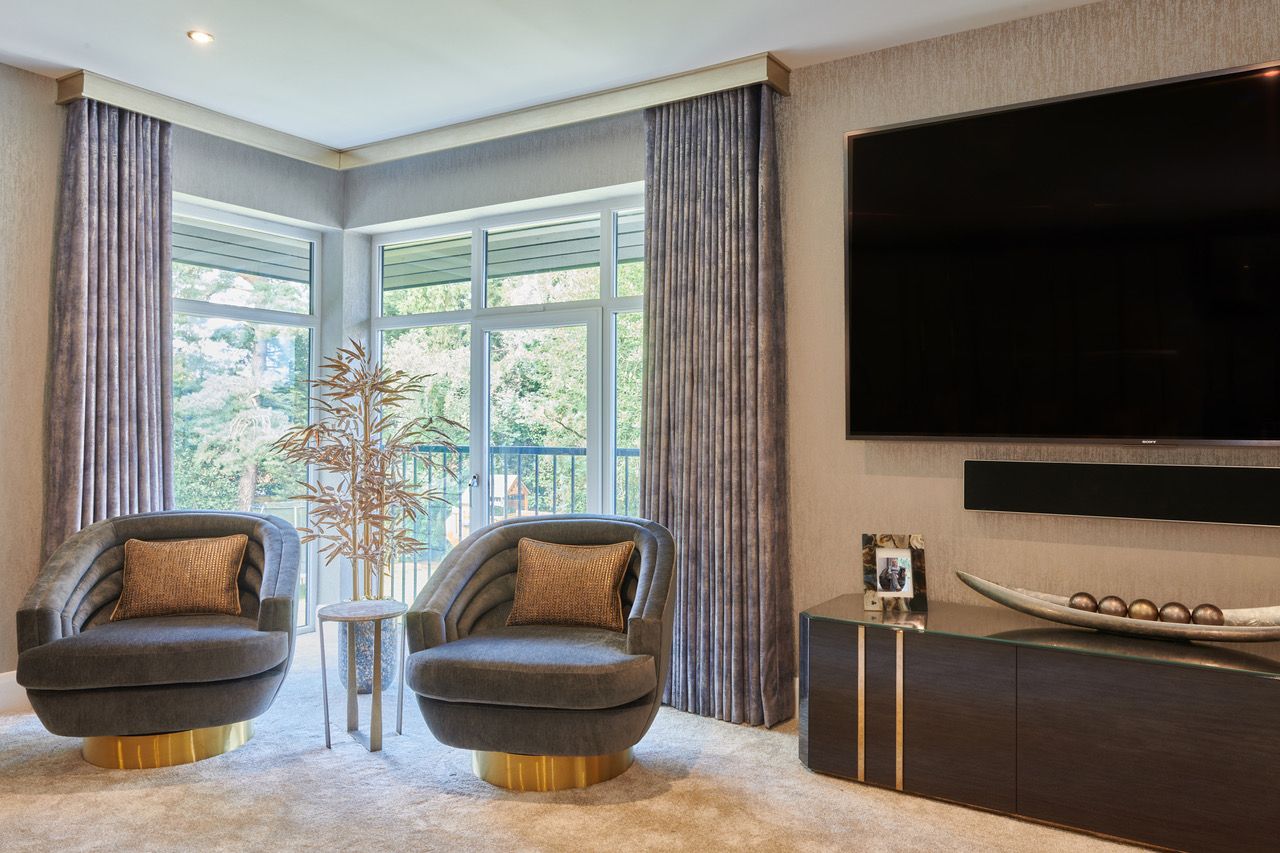
A bay window is the best source of daylight in most rooms that have one, and the hardest window in the house to dress. It has three or more faces at different angles, narrow piers between the glass and, very often, a radiator underneath. Get the curtains wrong and the bay becomes a dim alcove with fabric bunched in every corner.
Most of the decisions come down to what the curtains hang from and where they sit when they are open. The fabric and the heading come after that.
Bent tracks, bay poles or curtains across the front
A track bent to the bay
A track bent to follow the bay lets the curtains run the whole way round the glass. Fixed to the ceiling or to the wall above the windows, it lets the gliders run past the brackets, so a curtain can be drawn in one sweep from end to end. It is the most practical option and the least visible. The track has to be bent to the actual angles of the bay, not the ones on a drawing.
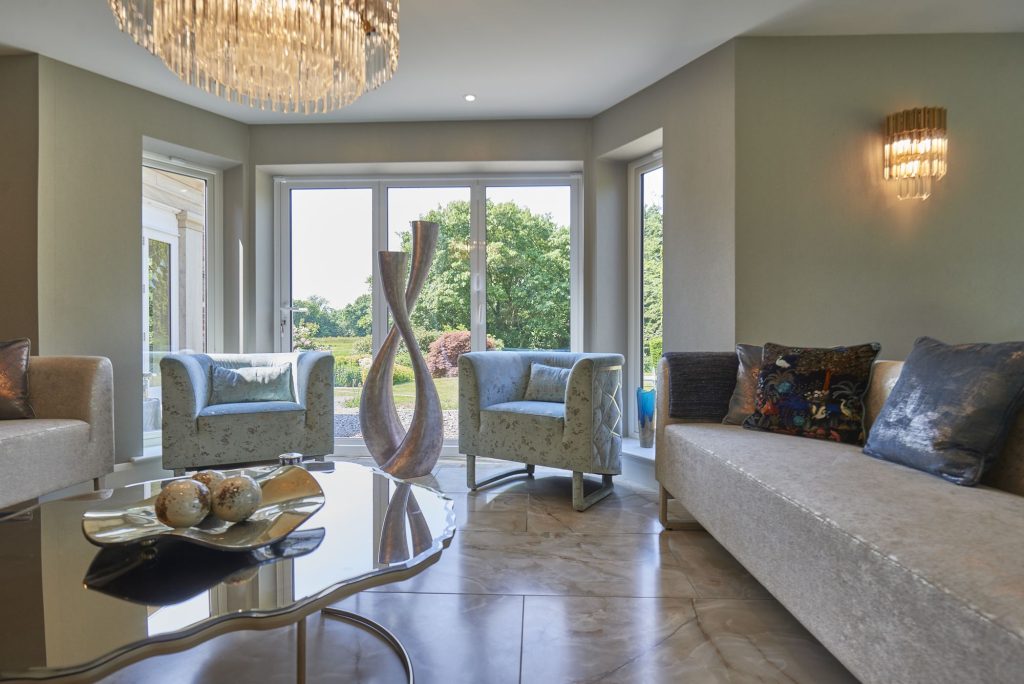
A pole with bay connectors
A pole with angled joints at each corner looks more traditional and suits a heavier curtain in a period room. The catch is the brackets. Ordinary rings cannot pass them, so each curtain is trapped in its own section unless the pole has passing brackets and open rings made to slide past. Without those, every curtain stacks against a corner pier, over the edge of the glass.
Across the front of the bay
The third option ignores the angles: a straight track or pole across the mouth of the bay, with the curtains stacking on the wall either side. In the day the glass is completely clear. At night the bay is shut out of the room, which suits a shallow, empty bay but not one with chairs or a desk you use in the evening. It needs enough wall either side of the opening to take the stack, and daytime privacy then has to come from blinds or sheers in the bay.
Where the curtains stack
Open curtains have to go somewhere, and in a bay the obvious places are the worst ones. The piers between the windows are often narrower than an open curtain, so a curtain parked on each pier covers the edges of two panes.
The better answer is usually fewer, larger stacks where there is no glass: at the two ends of the bay, or past them onto the flat wall beside the opening, if there is any. A heavy interlined curtain with a full heading takes up much more wall when open than a light one, so the size of the stack is worked out before the track is ordered, not after the curtains arrive.
Bay windows are standard on Cheadle’s inter-war houses, which is why tracks that stack clear of the bay come up so often in our interior design in Cheadle. In a room about four metres across, the bay supplies most of the daylight, so every pane matters.
Heading styles in a bay
The heading is the top of the curtain, and in a bay it affects how the curtain gets round the corners as much as how it looks.
- Pinch pleat sits formally and stacks tightly, which helps where the wall at the ends of the bay is limited.
- Wave hangs in an even ripple and suits a plainer room, but it needs a track made for it. Check the track can take a wave heading at the angles your bay has.
- Pencil pleat is gathered on a tape and reads softer and less formal than pinch pleat.
- Eyelet threads straight onto a pole, so it cannot run on a track or past a bay pole’s brackets. In a bay it only works where each curtain stays within one straight section.
Blinds, or blinds with dress curtains
A blind in each window is the neatest answer where the bay is shallow, where furniture sits in it, or where curtains would have nowhere to stack. Roman blinds give a soft, tailored line; rollers are plainer and almost disappear. Each is made to its own window, because the faces of a bay are rarely the same width.
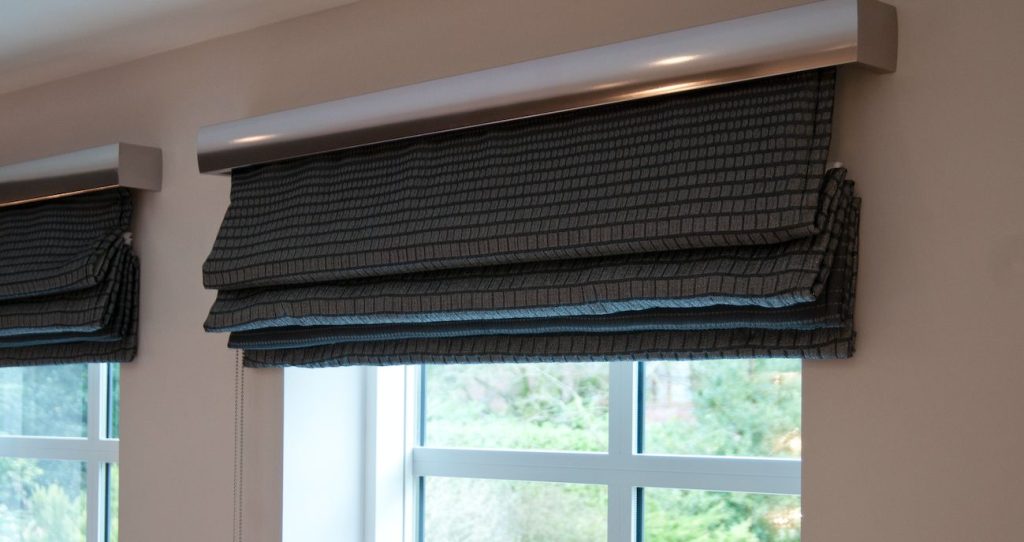
Two details matter. A Roman blind pulls up into a stack of folds, and if it is fitted inside the recess that stack sits across the top of the glass; fitted above the frame, it can clear it. And blinds inside the recesses of an angled bay can catch on each other at the corners, so the fixings are planned for the whole bay.
Blinds also pair well with dress curtains: fixed curtains at the two ends of the bay that are never drawn. They frame the window while the blinds handle privacy and light. Because they never close, they take less fabric, and they can carry a stronger pattern than you would want drawn across the whole bay every evening.
Sheers
A bay at the front of a house faces the street, so the room often needs privacy in the day as well. A sheer gives that without shutting out the light. It can hang on its own track behind the main curtains, with both tracks bent to the same angles, or be the only fabric in the bay, with blinds for the evening. Sheers stack too, so allow for them.
Lining and interlining
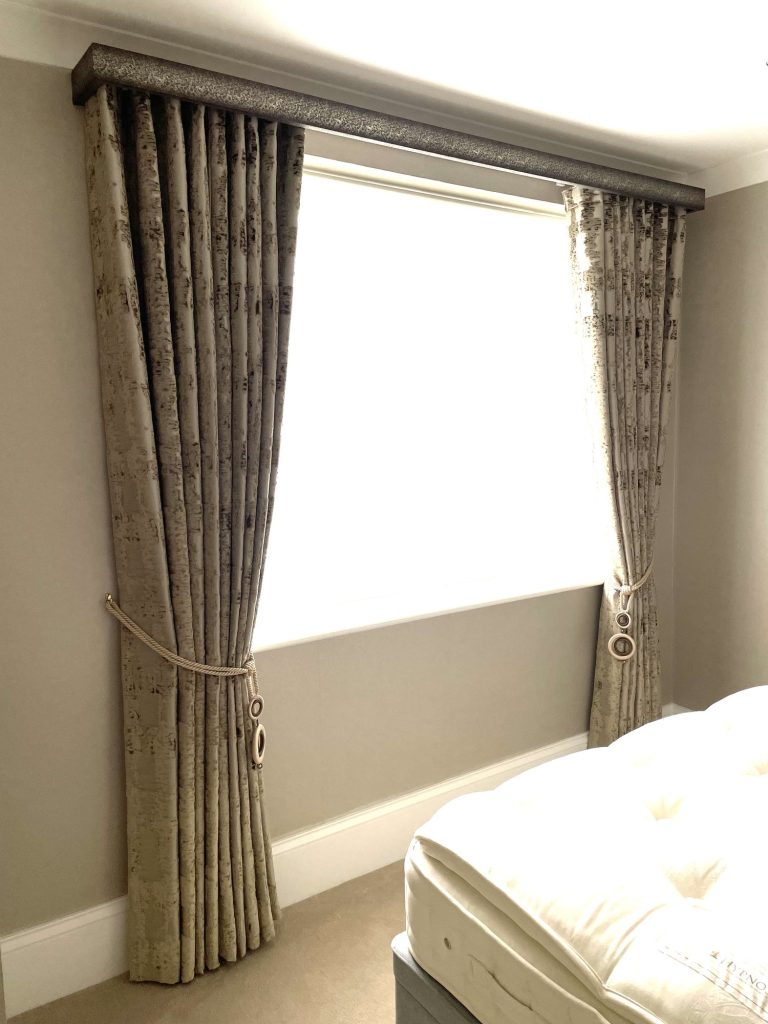
A bay is a lot of glass, and a room loses a good deal of warmth through it. Lining protects the face fabric from the sun and gives it body. Blackout lining stops light through the cloth, which matters in a bedroom. Interlining is a soft layer between the face fabric and the lining: it makes a curtain hang in heavier, more even folds and keeps more of the warmth in the room. It also makes the curtain bulkier when open, so interlined curtains in a bay need more wall at the ends or a heading that stacks tightly.
Radiators under the window
Radiators were put under windows to counter the cold coming off the glass, and in a bay that is usually where they are. Full-length curtains drawn over a radiator trap its heat between the fabric and the glass, where much of it goes up the window instead of into the room.
Curtains that stop at the sill leave the radiator below free to heat the room. Blinds with dress curtains keep it clear altogether. Curtains across the front of the bay leave the radiator heating the bay rather than the room, so they suit a bay without one. If the room really wants full-length curtains following the glass, moving the radiator is a question for your plumber, best asked before the curtains are ordered.
Measuring a bay
Bays are rarely square. Each face is a slightly different width, the corners are seldom the angles they were drawn at, and in older houses neither the ceiling nor the floor is quite level. A track bent to an assumed angle misses the corners, and a curtain made to a single drop can skim the floor at one end of the bay and hover above it at the other. That is why curtains and blinds are made to order and measured on site, with the angles taken at the fixing line and the drop measured at several points along the bay.
Starting with the window
Curtains force decisions about colour, pattern and light that the rest of a room then has to answer, which is why many of our projects as an interior designer in Wilmslow begin with curtains and grow from there. There is no minimum project, though, and a single pair of curtains is normal work. How linings, headings and tracks are specified is set out on our curtains and blinds page.
The curtain fabric books are in the showroom on Vicarage Lane in Bowdon, open Monday to Saturday from 9am to 5pm. Bring a photograph of your bay, or tell us about it through the contact page and we will come and measure it.